If you own more than a couple of hundred books, you have probably bought one twice. A simple catalogue fixes that, and it does not have to be a project. Here is a method that works for most home libraries.
1. Decide what "where" means for you
The most useful thing a catalogue can tell you is where a book is. Think about how your books are actually spread out:
- by room (living room, bedroom, office)
- by furniture (the tall shelf, the nightstand, the box in the closet)
- by status (owned, on loan to a friend, in storage)
Write down three to six locations. You can always add more. Do not try to reproduce the exact order of every shelf; "Living room, tall shelf" is enough to find a book in under a minute.
2. Scan, do not type
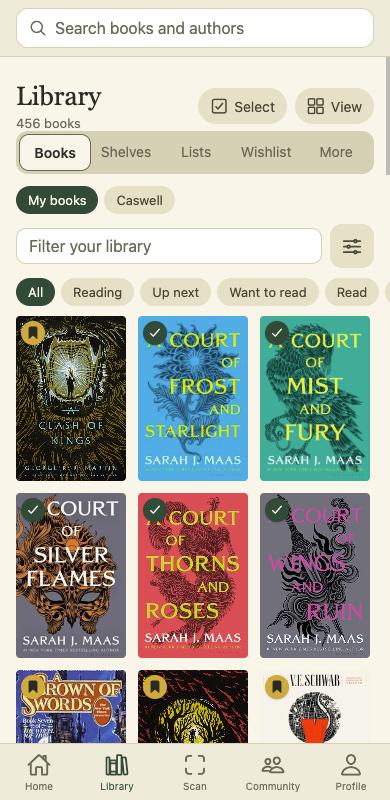
Typing hundreds of titles is what makes people give up. Almost every book has a barcode (the ISBN), and a phone camera can read it in a second. In Spinefolk, open Scan, point at the barcode, and the book is added with its cover, page count and details. Do a shelf at a time: pick a location first so each scan lands in the right place.
If a book has no barcode (older or self-published books), search for it by title instead, or add it by hand.
3. Treat editions as one book
Most people own the paperback of a book they also have as an audiobook, or two covers of the same title. A good catalogue treats these as one book with several editions, so your rating, your reading status and your review follow you instead of being scattered. Spinefolk does this automatically, and you can still pick the cover you like best.
4. Record what only you know
A catalogue becomes valuable when it holds the facts you cannot look up:
- Condition (like new, well read)
- Signed or first edition notes
- Where you bought it and what you paid, if you track your collection's value
- Who has it right now, if you have lent it out
These details stay private to you.
5. Keep it up to date with one habit
Skip the big annual cleanup. Instead, scan a book the day it arrives. If you also mark books you are reading and finishing, your catalogue maintains itself.
6. Use series to spot gaps
Collecting a series? A good catalogue shows which numbers you own and which are missing, in order, so you stop buying book three when you already have it and book two is the one you need.
Common questions
What if I have thousands of books? Work location by location over a few weekends. Scanning is fast; a shelf of fifty books takes about ten minutes.
Do I need to own a book to track it? No. You can also mark books as borrowed from a friend or the library, so your "owned" count stays honest.
What about e-books and audiobooks? Track them too, with the format noted, so everything you read lives in one place.
Spinefolk is a free app built for exactly this. Start your catalogue, or read our guide to lending books and getting them back.
Keep track of your books, free
Scan your shelves, lend books, and watch for releases. No ads.
Create your free account